

This is a guest post from Gonçalo Costa, the wicked-smart philosopher behind The Respectable Thomist. Gonçalo approached me about a guest post, so I asked him to write a blog about something that has always puzzled me: Aquinas’s Fourth Way. Make sure to go subscribe!
The question of the existence of God is paramount to every other question. It is no small matter to say that it ought to determine your ethics — not only by determining your duties, but also your intrinsic value, and the meaning of your life —, but it ought also to determine a whole other lot of things… your politics, your economics, your pedagogy, and so on.
On the face of such evidence, it is staggering to think that most of our brothers and comrades in life do not even stop to pose the question; or, worse still, give superfluous answers without much thought.
Well, of course, not all men can be philosophers and theologians; but then, not all men can be president or mayor, and everyone seems very knowledgeable of such things.
It is to such a question that this post is devoted.
I started Aquinas and Beyond to help everybody better understand Catholic philosophy. This is a free post, but premium subscribers are becoming thoughtful, well-formed Catholic intellectuals through:
A guided tour through the ENTIRETY of Thomas Aquinas’s Summa Theologiae, which you are reading right now! Don’t miss out on forming your mind according to the Universal Doctor of the Church!
Founding Members get a FREE copy of my Catholic Philosopher In A Year Reading Plan, my ultimate reading list to get up to speed in Catholic Philosophy.
Blogs on the philosophy of religion (God, evil, free will, etc.) like this one about art and the problem of evil.
Reader’s Guides on the great works of Catholic philosophy, like last month’s guide on Jacques Maritain’s Art and Scholasticism.
Further reading recommendations on many posts, including free posts.
Stop feeling confused in deep Catholic conversations and start thinking like a Catholic philosopher.
The God question
The Theologian, because his job is to speak about God, will have to ask this question right at the beginning, before he does anything else. How will he tell us the marvels of God’s nature, God’s innermost Trinitarian life, God’s gift of grace, or God’s gracious providence, if he be not sure that there is such a God?
The Philosopher, on the other hand, because he’s rather concerned about what he can see (and one cannot see God on this Earth), will ask the God question by the end. Contemplating reality, asking for its causes, the Philosopher climbs the ladder which bridges creation back to its Creator. He’ll eventually come to the certainty that, if there is such a world, then there must be such a God!
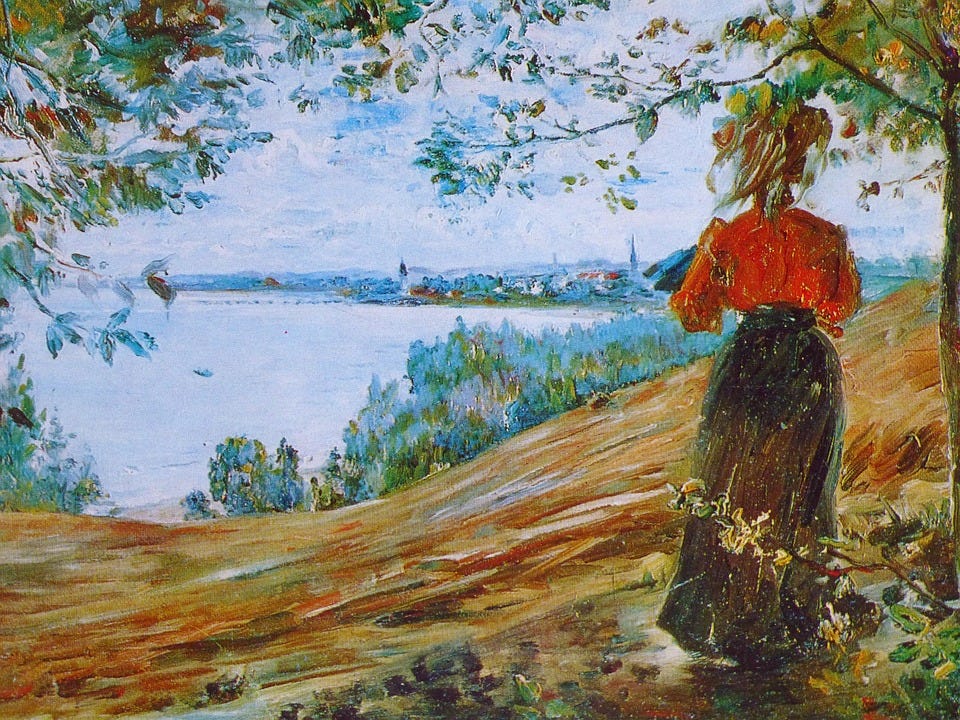
But, between the Theologian and the Philosopher, the everyday man (which might very well be both a theologian and a philosopher) will ask this question whenever he pleases. He might ask it at the bakery, or at the theatre, or even at school. Of course, one cannot grant him that the baker, the actors, or even his teachers, will know the answer. But the man may still find its answer, if he looks closely at reality.
For, pray, think for a moment. Does he not find good, sweet things, at the bakery? Does he not find beautiful things at the theatre? And does he not find true things at school? Today, I will propose to the reader that these things can be used to show that God exists.
Saint Thomas Aquinas’ Five Ways
It has been claimed before that, following Saint Thomas, anything would serve as the starting point for a demonstration of the existence of God — both respectable things, like oranges, daisies, and sunrises, and even despicable things, like bureaucrats.
The matter of fact is that Saint Thomas offers, at the debut of his Summa Theologiae, a set of five arguments. All of them are arguments from causality, meaning that they all start from some feature of the world which has some trace of being an effect.
Think of it this way. If I see something which is clearly an effect, it follows that there clearly is a cause. But a thing cannot be caused by just anything. Think — you see a squirrel; you ask me for its cause; I say, “A glass of water is the cause of this squirrel.” You’d conclude that I’m nuts, and feed me to the squirrel.
No. The cause must be proportionate to the effect. Thus, if you can find an effect whose proportionate cause can only be such a thing as God… then you’ll have all you need to show that God exists. It might sound super complicated, but Saint Thomas finds quite ordinary things. Imagine this story.
Walking home after school, John sees Susan, and immediately falls in love.
(One may be tempted do judge John, but Susan was indeed very beautiful, and, particularly, a lot more beautiful than John’s sister, who is, basically, pretty much the only woman whom John sees regularly.)
Despite having led a somewhat shameful life, he’s a brave man, so he takes a pen and paper, and writes a note asking her out, which he instantly delivers.
She reads, blushes, accepts, and they immediately go to the nearest bakery.
They see the baker make the most good looking bread, and they eat a piece each.
They taste one another’s bread, and conclude that Susan’s is best.

Then, they laugh so much together, that John’s belly aches. He accidentally falls off his seat, falling on the floor. Susan seems worried, but John laughs, and they laugh together.
In doing so, John perceives that his previous shameful life was meaningless.
There are over 20 things here which would satisfy Aquinas’ requirements; and there are five different ways of going about doing it, that is, of going from creature to God.
I will focus on one of these, probably the most misunderstood — the fourth way.
The Fourth Way
As for the text itself, the reader may just as well read it himself.
The fourth way is taken from the degrees that are found in things. In fact, there is found in things something more and less good, and true, and noble, and so of others like this. But more and less are said of diverse things inasmuch as they approach in diverse modes something which is maximally such, as the more hot is that which approaches to the maximally hot. Therefore, there is something which is the truest, the best, the noblest, and, consequently, maximally being, for those things which are maximally true are maximally beings, as it is said in Metaphysics, book 2. However, that which is said maximally such in some genus is the cause of all that are in that genus, as fire, which is maximally hot, is the cause of all hot things, as it is said in the same book. Therefore, there is something that is, for all beings, their cause of being, and goodness, and of any perfection, and this we call God. (ST, Iª, q. 2, a. 3, co.)

I will not contest the reader that this text seems very intricate and rather obscure. Removing some references to Aristotle and an odd illustration about fire, and adding some presupposed premises, we can reconstruct the argument as follows.
There is in things something more and less good, and true, and noble, and so of others like this.
But more and less are said of diverse things inasmuch as they approach in diverse modes something which is maximally such.
∴ Therefore, there is something which is the truest, the best, the noblest.
Now, those things which are maximally true, good, noble, or the like, are maximally beings.
∴ Therefore, there is something which is maximally being.
But that which is said maximally such in some genus is the cause of all that are in that genus.
∴ Therefore, there is something that is, for all beings, their cause of being, and goodness, and of any perfection.
But this is what we call God.
∴ Therefore, God exists.
Thus reorganizing the argument, we can separate the premises (1, 2, 4, 6, and 8) from the intermediary and final conclusions (3, 5, 7, and 9). Now, for the purposes of this post, I will take 1 and 8 for granted. That is, I will take for granted that
some things are better than others (after all, a piece of bread can be better than other; a person can be better than another; and the goodness that there is in studying is not as good as the goodness of knowing);
and that the following is a satisfactory notion of God: a maximally perfect being (maximally good, true, noble, beautiful, wise, etc.), which is the cause of the being (ie., existence), goodness, truth, nobility, beauty, wisdom, etc., of all other things.
We’re thus left to consider 2, 4, and 6. Let’s go for number 4 first.
The Transcendentals
Premise 4 claims that those things which are maximally true, good, and so on, are maximally being. The root for this is the philosophical doctrine of transcendentals. These are “properties” that each and every being has inasmuch as it is a being. These are traditionally considered to be five: thing (res), unity or the one (unum), something (aliquid), truth or the true (verum), and goodness or the good (bonum).1 We must clarify our terms.
A being is that which is; that which exercises the act of “to be.”
But every being exercises that act in a definite, distinct way. This way, which is many times called its essence, nature, or quiddity, is what one means here by thing.
Also, every being has some unity to it; if it didn’t, it would be two beings.
Plus, in exercising its act of “to be,” each being is distinct from all others; it is not only a thing, but it is a thing different from the others, which is the meaning of something,
Now, a good thing is that which is desirable; and any being can elicit desire, to a greater or lesser degree.
Finally, and similarly, a true thing is one which can be known; which can cause a true judgement in a rational mind. But, again, any being can do that, to a greater and lesser degree.
This does not mean that every thing is equally good, or equally true. On the contrary, Aquinas’ fourth way demands that there be degrees of goodness and truth. The doctrine of the transcendentals, rather, requires that there is a convertibility between being, goodness, and truth — if something is barely a being, then it is barely good and barely true; but, if it is the supreme being, then it must be supremely good (ie., desirable) and supremely true (ie., knowable).

But, together with this, call it, “horizontal convertibility,” the doctrine of the transcendentals also requires a “vertical proportionality.” Ideas, dreams, colours, houses, and cats are not beings in the same sense; true enough, they all exercise the act of “to be,” but they do so in very different ways; they exercise it in proportional ways.
Now, in that same proportion, they are good, true, and so on. Thus, the maximally true thing is maximally being. Enough for premise 4.2
The Principle of Approximation
We’re left with premises 2 and 6. The first claims that degrees of F things (ie., of goodness, truth, etc.) imply the existence of a maximally F thing (ie., maximally good, truth, etc.). Not only that, but it claims that these “more and less F” things are said “more” and “less” according to their proximity to this maximally F thing. So is premise 2.
Premise 6 adds the nuance (which most Thomists agree to be already implicitly present in premise 2), that this maximally F thing is also the cause of all other, non-maximally F things.
Now, given what we have said so far, if this principle is true, then we have shown that God exists. But the principle certainly seems a bit bizarre. Are things more and less red by approximation to the most red thing? Are people more and less tall by approximation the the tallest person? Does Aquinas’ argument imply the existence of a smelliest thing?
The first thing to keep in mind is that our proof is solely concerned with those transcendental and pure perfections, not with everyday, so-called mixed perfections. The latter, while good, are not unqualifiedly good; they are not always good — it’s not always better to be red than not to be, to be tall than not to be, to be hot than not to be.
So, what premises 2 and 6 claim, they claim only of pure and transcendental perfections (or, at least, that is enough for the argument to work). Also, notice that premises 2 and 6 do not mention a “maximum of goodness,” but something “maximally good.” These may look the same, but there’s a big difference. A maximum of goodness is something which is the most good thing adjectively, just as any individual cake may be, at a given time, the most sweet cake, the best cake.
But a maximally good thing is the most good thing adverbially, meaning that it is good in an entirely different, higher way, compared to all other things. Thomists go on to say that it is good by itself, by its very essence and nature, while other things are good only because they receive their goodness by something else. (Which is not true of the sweetest cake, which is sweet in exactly the same mode as any other sweet thing, only it is more sweet.)
But, still, how can one justify such a principle? There are some divergent interpretations among Thomists themselves,3 but I will give the reader what I think is the most solid reading.
Aristotle’s Metaphysics
The reason why there is so much disagreement is simple. Since Saint Thomas himself is so short of words, Thomists had to rely on other arguments, which they find similar, in order to look for explanations. My proposal, however, is that we rather look for the only text which the fourth way itself actually mentions and references, and uses as an authority for the principle of approximation. That text is Aristotle’s Metaphysics, particularly book 2.
There, Aristotle is arguing that Metaphysics is the science which maximally considers truth. He does so by showing that Metaphysics considers what is maximally true. Such an argument, of course, must first show that there is such a thing as a maximally true thing. From this passage, Saint Thomas retrieves the principle of approximation.
Now, one cannot give a full account of this passage in such a brief post as this, but the following ought to be noted.4
Aristotle notices that lower beings (such as the kind of material beings that we experience daily) are caused, meaning that their existence is dependent on the existence of something else;
Aristotle notices that their causes are more stable and more universal than their effects, because they do not depend on as many things for their existence;
Thus, Aristotle concludes, these causes are properly more true than their effects, because, being more stable and universal, they are more knowable;
However, as Aristotle points out immediately, there cannot be an infinite series of such causes — which means that there must be a first cause, which is most being, because it is uncaused being.
This first cause, because it is maximally stable (ie., necessary) and universal, must be also maximally true.
The Fourth Way Reconsidered
Thus, our mystery is solved. The fourth way makes us notice that there are things more and less true. But that means that they are caused truths. But a cause must have (either equally or eminently) its effect (otherwise the effect would not be caused by the cause, but would come from nothing).
Thus, it is a true thing which causes a true thing. But the series cannot go up infinitely. There must be a first truth. This first truth is called maximally true, because it is the uncaused, causing truth, it is true by its very nature.
And, of course, the same thing goes for goodness, nobility, wisdom, unity, and so on. And for being! Accordingly, the very fact that these “degreed” perfections exist can only be explained by the existence of something which is subsistent perfection.
Back to the bakery
In conclusion, let us walk back to John and Susan at the bakery. John is in love. He may perceive how its new state is better than his previous one.
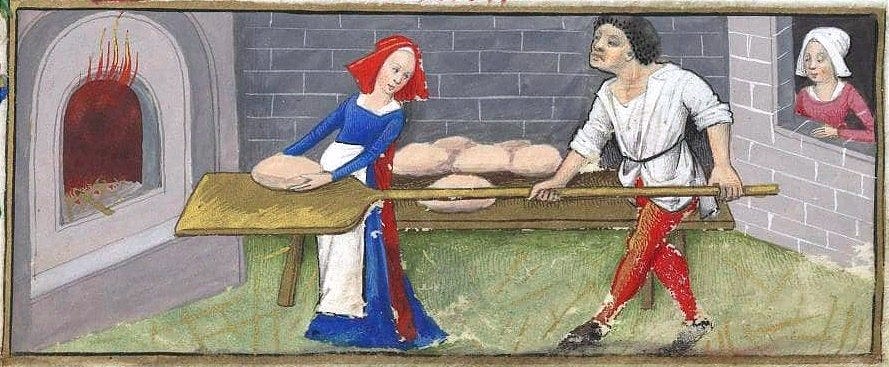
He may also perceive, faced with the light of the love he now feels, that his past, sinful life was more divided, and not as united as this new life he now desires. Or, if he had no sins, he would perceive that Susan was far more beautiful than his ugly, over-complaining sister. He may even remember that he agreed that Susan’s bread was better than his.
Now, of course, John’s reason is clouded by original sin, and he may be somewhat distracted by Susan’s beauty. But, with time and study, John may come to realize that his perceiving that his previous life was meaningless, had something to do with the testimony which creatures, that day at that bakery, paid to their Creator.
I am writing between teaching theology classes and playing with my kids. So, to put it bluntly, my time is not cheap. Please consider becoming a paid subscriber to help support my work and make it possible for more people to learn Catholic philosophy:
And go check out The Respectable Thomist!
Some people count six, as they count “being” itself. Some people add “beauty” to this list. The list as I’ve laid out is taken from Aquinas’ De Veritate, q. 1, a. 1, co.
The reader may have noticed that such things as “wise” are not counted in the transcendentals; rocks are beings, but rocks are not wise. Nonetheless, these are called “pure perfections” — perfections which, of themselves, do not imply any limit (unlike, say, “animality”). While these are not perfectly convertible in the lower levels of being, they are perfectly convertible in the uppermost end of the spectrum.
Just to give the reader a feeling, as I’ve recently conveyed it at the 99th American Catholic Philosophical Association’s annual meeting, trying to explain the principle of approximation: some have argued by the semantics of the terms “more” and “less;” some have argued by the metaphysics of participation; some have argued by the dichotomy “per se – per aliud;” some have argued by the application of the henological principle (ie., that multiplicity requires preceding unity). Plus, regarding the type of causality involved in proof: some have argued that it deals only with efficient causality; and some have argued that it deals also with exemplar causality; some have argued that it deals with both at the same time; and some have argued that it deals with both at different moments; some have argued that it deals also with final causality; and some have argued that it depends on the perfection in question; finally, some have argued that this obscurity is highly problematic; and some have argued that it brings no problem at all.
In this summary, I’m following Aquinas’ own interpretation of Aristotle, which one can easily find in his commentary to the Metaphysics.
 | A guest post by
|
I like how you framed this from the start as something that actually matters beyond just theory, especially tying it to how we think and live, not just whether the argument works on paper. The way you handled the fourth way was interesting too, especially clarifying the difference between something being the “best” in a category and being good in a completely different sense.
Thanks Gonçalo! (and Alex!) for a most enjoyable explication of the 4th way (adverbally "most"? or adjectivally "most"?).
Seriously, I think this is definitely a helpful direction for modern Thomists to move - engaging readers with up to date examples (avoiding Aristotle's, or even Thomas's less convincing analogies due to altered understanding of physics and how things work) or constructing scenarios to help make a memorable scenario and store a strong memory with which to thread the lines of reasoning across a wider neural network. So you can undertake a project (as each of you are) to bring the reasoning of the Angelic Doctor to a modern audience.
While it is not yet "Tic Tom(as)" I do think I could easily binge on a series of such presentations!